News

Cancel
  • Interview with Dr. Holger Althues (Head of the Battery Materials Department) and Dr. Benjamin Schumm (Head of the Particle Technology Department) / 2025

    New Battery Technologies: Efficient, Sustainable, Cost-effective

    News – Fraunhofer IWS Dresden / November 20, 2025

    Dr. Holger Althues, Head of the Battery Materials Department (left) and Dr. Benjamin Schumm, Head of the Particle Technology Department (right).
    © Fraunhofer IWS

    In this interview, Dr. Holger Althues and Dr. Benjamin Schumm discuss key questions about the future of battery development, such as: What challenges is research on new battery technologies currently facing? How does the DRYtraec process contribute to sustainable battery production? Which new materials and technologies are currently being explored at Fraunhofer IWS?

    more info
  • Advances in Dry Battery Coating / 2025

    Game Changer for Battery Cell Production

    News – Fraunhofer IWS Dresden / June 18, 2025

    © Martin Förster/Fraunhofer IWS

    Fraunhofer IWS has been conducting research into innovative solutions for solvent-free, dry electrode production since 2011. The focus topics of this research are sustainable and cost-efficient material and process developments. Especially in regard to the development of next-generation batteries, for example lithium-sulfur and solid-state batteries, the institute belongs now to the world‘s leading research and development (R&D) organizations. Practical innovations geared towards industrial benefits are created using a holistic approach which covers the entire value chain from material development and electrode production through to cell manufacturing.

    more info
  • First Successful Test of a Generatively Manufactured Aerospike Engine Using Hydrogen Peroxide-Kerosene Propellant / 2025

    Innovative Hot Gas Test: A Milestone for Aerospike Engines

    News – Fraunhofer IWS Dresden / February 06, 2025

    © Fraunhofer IWS

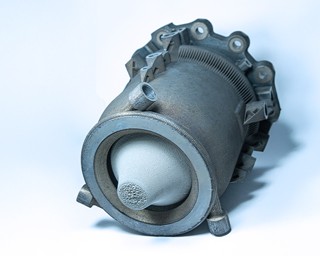
    A consortium comprising Fraunhofer IWS, the TUD Dresden University of Technology, ArianeGroup, and the Warsaw Institute of Aviation has achieved a significant breakthrough in aerospace engineering: the first successful hot gas test of a 3D-printed aerospike engine powered by a combination of sustainable hydrogen peroxide and kerosene propellant. This project was conducted under the ESA-funded ASPIRER initiative. The test results hold the potential to enhance the efficiency of space missions significantly.

    more info
  • Serial Sectioning Provides Insight into Materials / 2025

    Slicewise to 3D Analysis

    News – Fraunhofer IWS Dresden / January 15, 2025

    The robot performs the routine work, which makes everyday metallography easier. Processes such as grinding, etching and polishing are automated inside the robot.
    © ronaldbonss.com

    Methods such as computer tomography and ultrasound provide a non-destructive view into the interior of a workpiece. However, they provide too little information about the structure and properties of the material. Serial sectioning is a different matter. Although the sample part is gradually removed, the method offers clear advantages over non-destructive methods. Dr. Jörg Bretschneider explains the potential of serial sectioning, including with regard to automation using robots.

    more info
  • The Fascination of Materials: Innovation for a Sustainable Future / 2024

    Sustainable Material Design as Response to Resource Bottlenecks

    News – Fraunhofer IWS Dresden / May 22, 2024

    © Shutterstock/Fraunhofer IWS

    Finding solutions to potential resource bottlenecks requires sustainable material design. New material compositions enable more environmentally friendly ship propulsion systems, more economical aircraft engines or even lighter electric vehicles. At Fraunhofer IWS, the Competence Field Materials Characterization and Testing led by Prof. Martina Zimmermann is developing the “recipes“ for tomorrow‘s materials. The unique feature: Here, new alloys can be generated and analyzed directly using additive manufacturing methods. The 3D printers at the institute allow the newly developed recipes to be tested long before they are used in industry.

    more info
  • Joint Project “H2GO” Aims to Revolutionize Production of Mobile Fuel Cells / 2024

    Carbon instead of Gold: On the Road to Zero Emission Heavy Duty Vehicles

    News – Fraunhofer IWS Dresden / April 30, 2024

    © Shutterstock/Fraunhofer IWS

    Powerful mobile fuel cells can help to reduce the environmental impact of heavy duty transportation in Germany and worldwide in the future. 19 Fraunhofer Institutes from nine German states have therefore joined forces to form the development alliance “H2GO – National Fuel Cell Production Action Plan”. They aim to jointly develop industrial technologies to produce fuel cells and efficiently transfer new processes to industry. The focus is on fuel cells for road-based heavy duty vehicles. The Federal Ministry for Digital and Transport Affairs is funding H2GO with around 80 million euros from the “Future Fund for the Automotive Industry“ until the end of 2025. The Fraunhofer Institute for Material and Beam Technology IWS is also part of this consortium. Dr. Teja Roch oversees the “HP2BPP” sub-project at Fraunhofer IWS, located in Dresden and Dortmund. In this interview, he explains the innovative contributions.

    more info
  • Lasers Play Crucial Role in Dismantling Destroyed Nuclear Infrastructure / 2024

    “The Need for Solutions Is Enormous”

    News – Fraunhofer IWS Dresden / April 09, 2024

    © Fraunhofer IWS

    A dark chapter in human history unfolded in Chornobyl on April 26, 1986, when Block 4 of the nuclear power plant exploded, resulting in a meltdown. This tragic incident transformed the immediate surroundings into an uninhabitable landscape and impacted the environment and the health of the population in the long term. Decades later, humanity faces the urgent challenge of dismantling the damaged power plant. Researchers at Fraunhofer IWS in Dresden, who are tackling this complex task, recognize this necessity. Scientists of the Cutting and Joining Technology Field members work on a laser-based, remote-oper-ated dismantling process for contaminated material mixtures. In this interview, Dr. Andreas Wetzig and Dr. Jan Hauptmann provide insights into the background to this ambitious task.

    more info
  • Strengthening the German Academy of Science and Engineering / 2024

    Andrés Fabián Lasagni Is a New Member of acatech

    News – Fraunhofer IWS Dresden / April 03, 2024

    © Fraunhofer IWS

    The laser expert Prof. Andrés Lasagni was elected as a new member of the German Academy of Science and Engineering (acatech), during the last General Assembly.

    more info
  • Fraunhofer IWS: New Insights Gained for the Use of Digital Lab Notebooks / 2024

    “DiWan” Shows the Way to a Digital Materials Expert

    News – Fraunhofer IWS Dresden / February 06, 2024

    Digitalization is changing the job profile of materials testers. One critical criterion is to provide teams with sufficient training on new digital lab books. This shall secure expertise for companies and institutes in the long term. The Fraunhofer Institute for Material and Beam Technology IWS in Dresden and its partners have gained these and other insights from the now-completed project “DiWan: Digital change in materials testing.” The Dresden institutes incorporate those into their further activities in the digital transformation context of materials science and engineering.

    more info
  • Fraunhofer IWS and Partners Aim to Develop a Measurement System for Fast and Reliable Methane Detection / 2023

    Precise Mobile Tracking for Emission Reduction

    News – Fraunhofer IWS Dresden / May 24, 2023

    © Shutterstock

    The European Union has set itself the goal of better recording and further reducing methane emissions in the agricultural, waste, and energy sectors. In this context, the Fraunhofer Application Center for Optical Metrology and Surface Technologies AZOM, “Micro-Hybrid Electronic” and “fiberware” launched a research project for waveguide-based trace gas analysis of methane under the coordination of “DBI – Gas- und Umwelttechnik”. The aim is to develop a mobile compact handheld device that can determine methane emissions with a precision not previously possible. The project is being funded over three years as part of the BMBF's “KMU-innovativ: Ressourceneffizienz und Klimaschutz” (SME Innovative: Resource Efficiency and Climate Protection) funding measure (HLSG-CH4 for short).

    more info