 Fraunhofer Institute for Material and Beam Technology IWS
MEDIUS

LASENS module for monitoring and controlling laser microprocesses.
Initial Situation: An Evaluation-oriented Process Data Management and Processing is missing
The use of laser as a photonic tool in production is industrially established and has led to a change where conventional manufacturing methods are increasingly substituted by laser-based processes. The digitalization of production is pursuing the goal of optimizing productivity as well as the traceability of each individual process step, so that increasingly self-controlled automation and self-regulating processes are becoming possible. The use of cyber-physical systems (CPS) in the field of laser material processing requires a high level of investment, as established solutions are only insufficiently able to meet the high requirements due to the lack of implementation of modern interface concepts, inflexible data models and insufficient data availability, and thus represent cyber-physical islands at best. An evaluation-oriented data management and processing, which focuses on the analysis of laser process data and combines decentralized and centralized concepts, has not been established.
Research Solutions: Development of an AI-based Photonic Predictive Manufacturing System for Data-driven and Adaptive Laser Structuring Using Direct Laser Interference (DLIP)
The project addressed key challenges associated with digitalization in laser micromachining. To this end, a Photonic Predictive Manufacturing System was developed that combines a harmonized database, AI-supported predictive modules, and an AR-based user interface within an industrial laser system. The goal was to significantly reduce the considerable effort required for parameterization and analysis in Direct Laser Interference Structuring (DLIP).
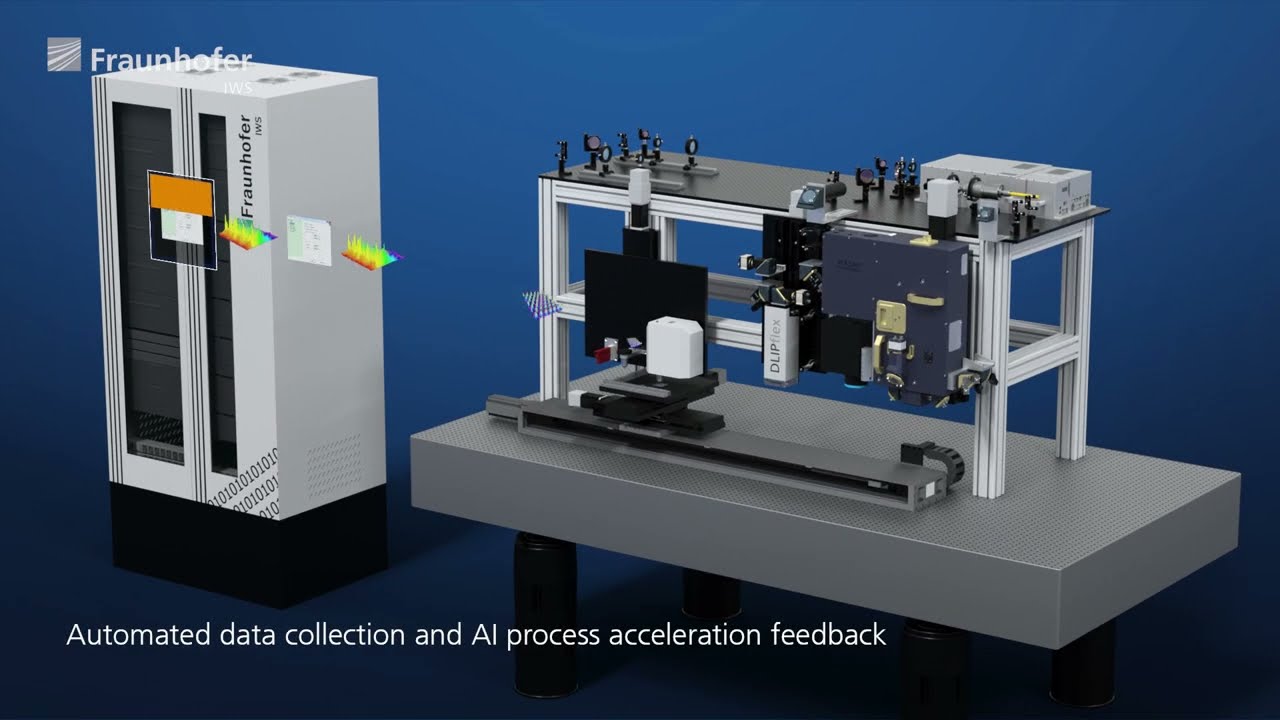
As part of the project, a cyber-physical DLIP module with integrated acoustic-optical inline monitoring was developed, capable of flexibly switching between different structuring methods. Based on the process data, AI methods for automated process monitoring and parameterization were developed. This allows the structure period to be predicted from individual acoustic pulse signals with an accuracy of up to 96%.
The prediction platform developed links laser and topography parameters with functional surface properties and enables their prediction as early as the process development stage. This significantly accelerates the development of functionalized surfaces. In addition, the acoustic monitoring system was further developed into the LASENSacoustic sensor module, which can be used in the future as an add-on module for laser processing systems.
Animation: AI Testbench – Predictive Modelling for Laser Precision Manufacturing
Privacy warning
With the click on the play button an external video from www.youtube.com is loaded and started. Your data is possible transferred and stored to third party. Do not start the video if you disagree. Find more about the youtube privacy statement under the following link: https://policies.google.com/privacy© Fraunhofer IWS
Added Value for Industrial Customers
1. Faster Process Development 2. Greater Process and Quality Reliability 3. Digital Knowledge Base 4. More Efficient Development of Functional Surfaces 5. Intelligent and Flexible Manufacturing 6. Easy Retrofitting of Existing Systems |