System Development

SHAPErotator – Flexible Handling of Shaped Beams for High-power Ultrashort Pulse (USP) Processes

SHAPErotator for high-performance ultrashort-pulse processes.
© Fraunhofer IWS
SHAPErotator for high-performance ultrashort-pulse processes.

Laser material processing with ultrashort pulse lasers is a high-precision and low-damage process that can be used to process even transparent or brittle materials with high quality. However, one limitation of this process is its low productivity, as it is often not possible to use full power to achieve high processing quality. One approach to meet this challenge is to distribute high laser powers over several partial beams operating in parallel. Classically, the spatial orientation of these beams is fixed, resulting in multiple parallel lines when scanning in one direction and only one line when scanning in the orthogonal direction. Similar limitations also exist when beam shaping elements are used to optimally adapt the intensity distribution in the single beam to the process, using non-rotationally symmetric beam shapes, such as an elongated beam. Here, too, the process result depends on the feed direction if the beam shape orientation is fixed. It is therefore necessary to align the beam shape in a controlled manner to the direction of the feed motion. In applications where the laser beam must follow a contour with changing directions (such as laser cutting), the alignment must be continuous and synchronous with the movement. The requirements for the dynamics of the beam shape alignment are very high, especially for scanner-based beam deflection. Up to now, there has been no technical solution for this.

The newly developed SHAPErotator optics module addresses this limitation by dynamically aligning the beam profile during the scanning process. This makes it possible to work with several partial beams simultaneously, with each beam containing the power required for optimum quality. The scientists are looking for partners from industry and research to test and further develop the system.

LASENSacoustic Module for Monitoring and Controlling Laser Microprocesses

LASENS module for monitoring and controlling laser microprocesses.
© Fraunhofer IWS
LASENS module for monitoring and controlling laser microprocesses.
Photos of a structured surface and a surface image calculated based on the acoustic emissions of the process. The defect caused by fluctuations in laser power is visible.
© Fraunhofer IWS
Photos of a structured surface and a surface image calculated based on the acoustic emissions of the process. The defect caused by fluctuations in laser power is visible.

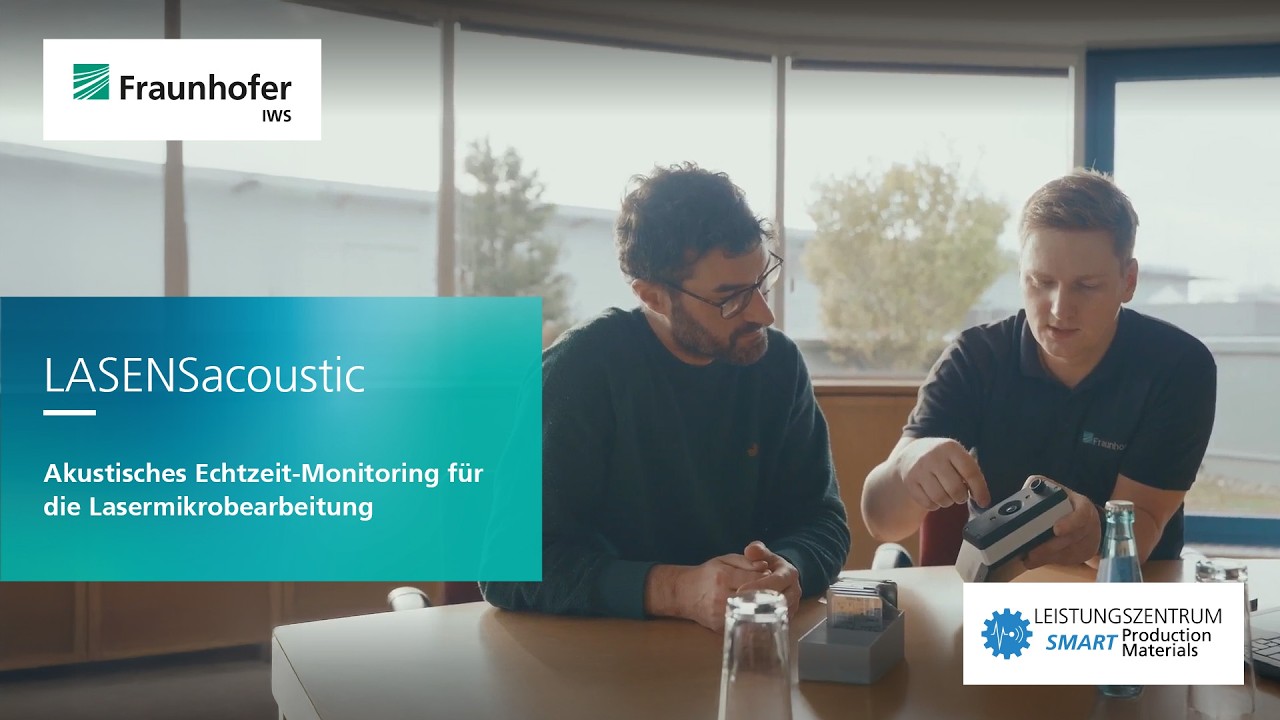
Sound emissions reveal whether a laser process is running smoothly or becoming unstable. Fraunhofer IWS has developed a real-time acoustic monitoring solution that analyzes laser processing as it happens. The aim is to provide cost-effective and robust process control by identifying deviations early. A first market-ready monitoring module is already available.

The module was developed as an extension for existing machines and uses the sounds of laser ablation for process control and improved quality control. For this purpose, two-dimensional acoustic mapping of the process emissions is performed. LASENSacoustic also enables real-time monitoring of the working position and uses acoustic comparisons to ensure that the process has been carried out identically. In addition, it allows active monitoring of process parameters such as laser power or frequency.

Compact DLIP systems and equipment

DLIPscan module for scanner-based surface.
© Fraunhofer IWS
DLIPscan module for scanner-based surface.
Die 3D-Laserstrukturierung von Zellkomponenten soll die Leistung und Kapazität von Batterien optimieren.
© ronaldbonss.com
Die 3D-Laserstrukturierung von Zellkomponenten soll die Leistung und Kapazität von Batterien optimieren.
Left: Simulation of the intensity of the interference volume generated by two focused laser beams: a) ablation on the material above the working point; b) inside the working point; c) below the interference volume. Right: Variation of the acoustic signal as a function of the z-position of the interference volume with respect to the surface.
© Fraunhofer IWS
Left: Simulation of the intensity of the interference volume generated by two focused laser beams: a) ablation on the material above the working point; b) inside the working point; c) below the interference volume. Right: Variation of the acoustic signal as a function of the z-position of the interference volume with respect to the surface.

DLIP Modules: DLIPscan, DLIPflex, …

The latest generation of DLIP processing heads allows to vary the structure period as well as orientation during processing. Thus, a wide range of surface structures can be realized with one system and process step. On the one hand, the processing heads are offered individually and can be used e.g. in existing and robot-assisted laser systems. On the other hand, Fraunhofer IWS offers compact DLIP systems in which the head, the associated periphery (laser, housing, etc.) and a specially developed control software are already integrated.


DLIP Roll-to-roll Plant

Our goal is to keep the cost of an area to be processed as low as possible. Currently, we have achieved process rates of up to 0.9 square meters per minute at Fraunhofer IWS with laser processing. At the TU Dresden, with whom we are conducting joint research on the DLIP process, even 1.6 square meters per minute were possible by using polygon scanners. Even higher process rates are achieved with a roll-to-roll system. Here, it is not the film that is directly structured, but a stamp that forms the structure onto a film via a roll. Process rates of up to 10 square meters per minute can be achieved here.
 

Process Monitoring (Acoustic)

One strategy for process monitoring at DLIP, for example to treat complex and non-planar surfaces, is the detection and analysis of photoacoustic emissions. Over the last 35 years, it has been shown that the acoustic pressure generated by the impingement of a laser beam on a surface, leading to ablation, can be detected and analyzed with simple and commercially available transducers and microphones. Fraunhofer IWS characterizes the acoustic emissions during the production of linear microtextures with different spatial periods and depths, interprets the spectral signatures resulting from single point and interference ablation, and investigates the vertical extent of the interference effect based on the ablated area and its variation with interference period.
 

Prediction Modeling of Surface Properties

As the performance of functional surfaces increases, the prediction of the resulting surface properties becomes increasingly important to reduce the development time for these functionalities. Consequently, advanced approaches to predicting the properties of laser-processed surfaces – known as predictive modeling – are needed. The findings from the analysis of photoacoustic emissions during the structuring process carried out at the institute enable the development of an autofocusing system that uses only the acoustic emission signals for 3D processing. This makes it possible to predict deviations in the DLIP processing parameters.